
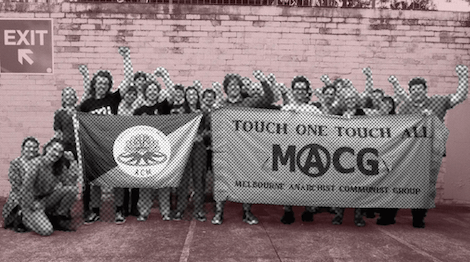
The following article first appeared in Arbetaren, #38 2024.
On the 13th of April 2024 a conference to discuss the possibility of an Australian federation of Anarchist-Communists was held in Brisbane by Melbourne Anarchist Communist Group and Anarchists Communists Meanjin. Geelong Anarchist Communists sent two delegates as observers. The following article was written for Arbetaren, the Swedish Syndicalist newspaper and observes the purpose of the conference and contains a basic exposition of anarchist-communist ideas.
Andrew sits behind the wheel with sunglasses and rolled down windows. The heat is almost tropical, even though it’s nearly winter, as the car travels up and down the steep roads of Brisbane. He, along with anarchists from all over Australia, is on his way to a conference for the launch a new Australian anarchist federation.
The working class lives in the valleys while the bourgeois live higher up. It is always the workersvwho suffer from the floods. They’re known as the ‘valley people’, he says.
Andrew is a member of the relatively new Anarchist Communists Meanjin (ACM), Brisbane’s libertarian communists, and he is one of the organisers of the conference.
There are many reasons to establish a federation. In Australia, over the last three years, we’ve seen a number of anarchist organisations starting up. Those organisations share the same kind of politics, Platformism or whatever you want to call it, and have a similar view of the labour movement. And for anarchism to actually accomplish the tasks we’ve set out – carrying out the revolution, building a strong working class and, you know, creating socialism – requires a high level of organisation, says Andrew.
It strengthens anarchism as a whole by establishing a federation, given that it’s built on a solid foundation. We’ve seen how the organisations from city to city have developed their own training programs and strategies, and that’s good. But there comes a time when development must be advanced to form a national organisation, because the working class does not exist in isolation. In Australia, there is neither a trade union nor a political counterforce like the SAC in Sweden. Instead, the most radical segments of the labour movement have turned to so-called platformism. This is an organisational theory within the broader libertarian socialist movement, to which syndicalism also belongs to. They see how the working class has been subjugated by its unions, but also recognise that unions are the organised form of workers and the only organisation capable to challenge the social and economic order.
Instead of building a syndicalist organisation from scratch, they seek to build an equally radical and base democratic organisation from within. This requires strict unity in theory, strategy and practice, they say. This is practiced in a specific anarchist organisation that exists outside the unions, but is systematically engaged with and tries to influence the unions to become more democratic and autonomous. The organisation is made up of determined union members who organise workers according to base democratic principles, create union organisers, and support other members with legal and practical help where the bureaucratic unions lack commitment, competence and courage.
The conference papers describes previous attempts to form federations. The numerous attempts in the 1970s to bring all kinds of anarchists together in a federation resulted in a chaotic and and short-lived organisation that turned many away from anarchism. The remaining anarchists that still believed in class struggle formed the Anarcho-Syndicalist Federation (ASF) in 1986. But it never grew to much more than thirty members, partly due to its failure to work and profile itself as a trade union and not merely as a political grouping. The already small ASF split in 1992 after a dispute over the membership magazine and the organization never recovered. According to Andrew, there hasn’t been an anarchist movement in Australia for a long time.
Many have called themselves anarchists, some have acted accordingly, some imagine that an anarchist movement has existed but it’s been a long time – if ever – since we’ve seen an anarchist movement actually act as a movement; pursue anarchist politics and have any actual political impact. He says Australian anarchism has been individualistic and subcultural, although there have been some exceptions.
But now we’re seeing new organisations emerge and others have been revitalised. I wouldn’t say we’re seeing an anarchist movement quite yet, but we are seeing a regrouping of organised anarchism and an attempt by them to form a solid base that helps build and influence the workers’ movement and the class struggle.
The ACM’s premises in central Brisbane, the Common House, houses a library, kitchen and meeting rooms. The walls are decorated with union banners and flags, the Eureka flag symbolising workers’ power and workers’ resistance drapes one of the doors.
The chairs are quickly filled by some thirty delegates and observers from Brisbane, Melbourne, Geelong and one from Sydney. At the front, the chairperson, secretary and meeting facilitator are already in place. As the clock strikes nine, the meeting opens and the first discussion points are dealt with.
One of the conference participants is Kieran from the Melbourne Anarchist Communist Group (MACG). He makes the following set of observations:
The Australian labour movement is at rock bottom. We are living in the aftermath of the accords of the 1980s that emerged from the strike explosion of the 1970s,’ says Kieran. He says that over the past 40 years, union membership has fallen from almost 50% to just below 12%. At the same time, the right to strike has been curtailed to the point where strikes are almost illegal.
The current leadership of the labour movement sees the accords as a good thing, and that the problems we face are due to Liberal rule rather than compromises we ourselves have made within the movement, and that the solution is a Labor government. But we have Labor in power, and the problems remain. We need to organise as anarchist communists to pursue policies that rebuild the labor movement. But there are some unions that are more democratic and participatory than others, Andrew adds.
Even the most militant ones are still tightly controlled. Take my union for example, the Australian Services Union. Recently, when I organised my workplace, and got close to 50 percent on board and started discussing an EBA campaign, the response from the union was that they were not interested in organising for better wages, but that they were more interested in working with management to push the issue of wage increases at a political level instead. That’s where we have much of the unions today. They function in many ways as an extension of the Labor Party and their politics, but the unions have much more potential than that. He believes the anarchist organisation can bring that potential to life and become the driving force in
the class struggle.
But that doesn’t mean that the working class becomes anarchist or that we persuade workers to become anarchists, I understand it more as we have to persuade the working class become more militant, and to wage class struggle outside the state apparatus. Class autonomy rather than attachment to political parties, and trade unions as democracies run by the workers themselves rather than bureaucrats.
The conference address one of the first concrete tasks of the Federation, namely the creation of industrial committees at national level. Industrial committees are formed by working members operating in the same industry. Their role is to coordinate union struggles, share strategies and disseminate relevant information within their industry and, in the long term, to coordinate union militants and influence the rank and file, as well as organising union campaigns. The federation will also develop union strategies and create an education program for members. As the clock approaches seven o’clock, the conference decides to form a preparatory committee for an inaugural congress next year. The mood is one of excitement, as if what has been decided is a fundamentally important moment in the history of the anarchist movement.
It feels a bit surreal, to be honest, says Andrew afterwards. I’ve called myself an anarchist since I was fifteen, although I only started getting involved five or six years ago. And when you engage to this level in the class struggle, it can be difficult sometimes, difficult to be a revolutionary. But to see anarchists from different organisations coming together today, having such deep and insightful discussions, and showing the level of coherence that there is with a desire to build something bigger. Yes, it’s surreal, but heartwarming. It feels incredibly positive that we are continuing to move forward and be able to see what can be achieved together.
(Written and translated by Cim-Héloïse Sävel)
Following the conference, MACG and ACM released a joint statement that can be read here.
 Anarchist Communist Federation - Geelong